
Your lease end date is the deadline everyone remembers. The one that catches people out is the strata one — the notice you were supposed to give, the lift you were supposed to book, the two-hour window your building actually allows moves to happen in.
Get it wrong and you don’t just annoy the building manager. You can be turned away at the loading dock with a truck idling outside and a crew on the clock.
Here’s what a Sydney owners corporation can require from you, what it can’t, and the questions to ask before you book anything.
The rules come from your building, not from the government
Strata in New South Wales runs under the Strata Schemes Management Act 2015. But the Act mostly sets the frame. The rules you’ll actually be held to are your building’s by-laws — a registered set of rules specific to your scheme.
Every scheme is different. There’s a set of model by-laws that many buildings adopt as-is, but yours may have replaced them, added to them, or written its own from scratch. The moving rules in a 1970s walk-up in Newtown and a 2019 tower in Zetland will not be the same document.
This is the single most useful thing to understand: nobody can tell you your building’s moving rules except your building. Not us, not a blog post, not the last place you lived.
Common property is the whole issue
Your apartment is yours. Nearly everything between your front door and the street is not.
Lobbies, corridors, lifts, stairwells, fire doors, driveways, loading docks, car park ramps, garden paths — this is common property, owned collectively by the owners corporation. Every single item you own has to travel across it on moving day.
That’s why strata cares. Not because they’re precious about your couch, but because a lift wall dented at 2pm on a Saturday is a repair the owners corporation has to fund and organise.
The notice requirement
Most schemes require you to notify the owners corporation or strata committee before you move furniture through common property. The model by-law on moving furniture works exactly this way — it isn’t a permission slip, it’s a notice.
What “notice” means in practice varies enormously:
- An email to the strata manager
- A form submitted through a building portal
- A phone call to the on-site building manager
- Nothing at all, in older or smaller schemes
Lead times run from 24 hours to two weeks. Larger buildings sit at the longer end because the lift booking has to be scheduled around other residents.
Ask your strata manager, in writing: How much notice do you require for a move-out, and in what form? Keep the reply. If a dispute happens later, an email trail is the difference between an inconvenience and a bill.
Booking the lift
In any building with a lift, this is the step that actually constrains your moving day.
A service lift booking typically covers:
- A reserved time block, often two to four hours
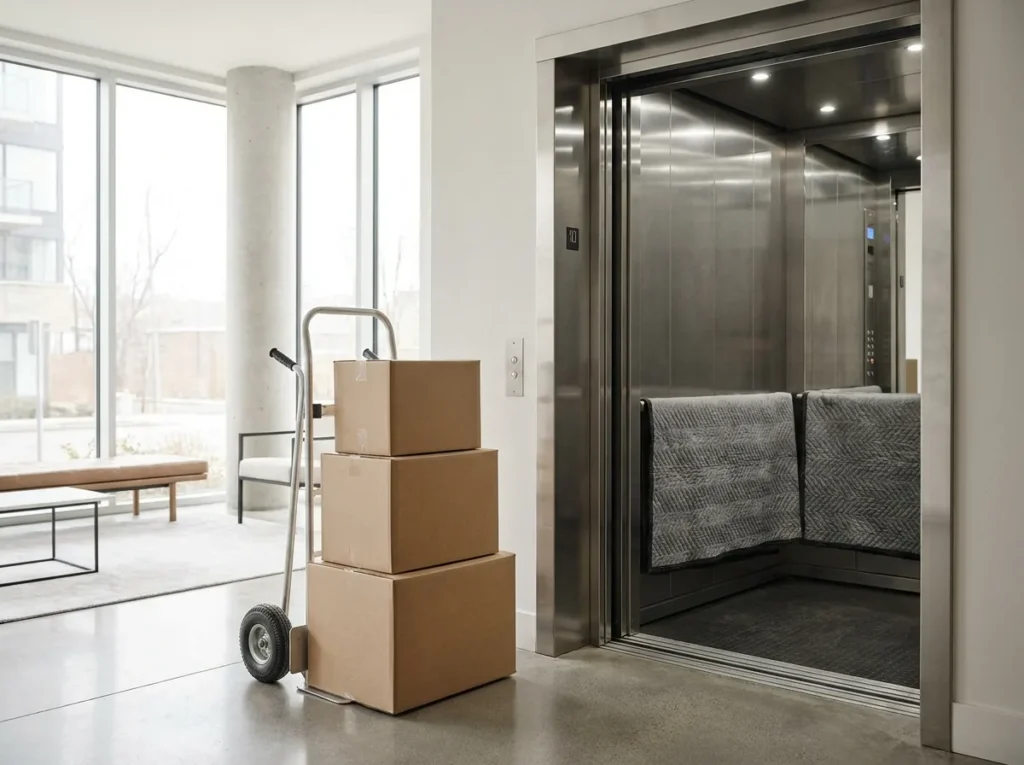
- Protective padding fitted to the lift interior (usually by the building, sometimes by you)
- A key or fob that holds the lift on your floor
- Sometimes exclusive use, sometimes shared
Weekend blocks — especially Saturday mornings at month’s end — go first. If your building only offers two moving slots a day and forty apartments are turning over in the same fortnight, waiting until the week before is how people end up moving on a Tuesday afternoon they didn’t want.
Book the lift before you book your removalist. Not after. The lift window is the fixed point; everything else moves around it.
The moving-hours window
Buildings routinely restrict when moves can happen. Common patterns:
- Weekdays 8am–4pm, Saturdays 9am–1pm, no Sundays
- No moves on public holidays
- No moves after 5pm on any day
- Complete bans on Sunday moves in residential-only towers
These restrictions are enforceable if they’re in a registered by-law. They’re also the reason an early start matters. If your building closes the dock at 1pm on Saturday and your crew arrives at 10am, a three-hour move has no slack in it at all.
Our apartment removalists page covers how we plan around lift windows and dock access.
Bonds and damage deposits
Many schemes take a moving bond — a refundable deposit held against damage to common property, returned after an inspection.
Anyone quoting you a standard figure is guessing. It varies by scheme, and some buildings take none at all. What is consistent:
- It is refundable, and it is separate from your rental bond
- It is usually held by the strata manager, not the landlord
- Release generally follows a common-property inspection after the move
- Some buildings also charge a non-refundable administration or lift-booking fee
Ask two questions: Is a bond required, and how much? And: What has to happen for it to be released, and how long does that take?
Who pays if something gets damaged
If your move damages common property, the owners corporation can pursue the cost of repair. That may come out of your bond. If the damage exceeds the bond, it doesn’t stop at the bond.
This is where the choice of removalist stops being about price.
Public liability insurance is the thing to check. Every crew we send holds it. If you’re comparing quotes, ask each company directly and ask for proof — a mover who hesitates on that question is telling you something.
Two practical protections, both cheap:
Photograph the common property before loading starts. Lift interior, lobby floor, corridor walls, the dock, any door frame your furniture passes through. Timestamped photos, before a single item moves. This is standard practice on every job we run, and it has settled more disputes than any argument ever has.
Confirm who is fitting the lift padding. If the building fits it, confirm it will be in place when your crew arrives. If you are responsible for it, find out the day before, not on the morning.
What strata cannot do
By-laws have limits. Under the Act, a by-law cannot be harsh, unconscionable or oppressive — and an owners corporation cannot prohibit you from moving out.
It can regulate when and how. It cannot refuse permission outright, invent a fee that isn’t in a registered by-law, or hold your possessions.
If a building manager is applying a rule you’ve never seen written down, ask which by-law it comes from. If they can’t tell you, you’re entitled to request a copy of the registered by-laws. If the answer still isn’t satisfactory, NSW Fair Trading provides free strata mediation.
You should not need this. But knowing the floor exists changes how the conversation goes.
Renting? Your by-laws are already yours
If you’re a tenant, your landlord or agent is required to give you a copy of the building’s by-laws when your tenancy starts.
Most people never open it. It’s in the folder with the condition report.
Find it before you plan the move. If you can’t, ask your agent for a copy — they have it, and asking costs nothing. It will name the moving hours, the notice period, and whether a bond applies, and it will settle the question in five minutes rather than five phone calls.
Your strata checklist, in order
- Find your by-laws. From your agent, your strata manager, or the building portal.
- Ask the strata manager, in writing: notice period, lift booking process, permitted moving hours, bond amount, bond release process.
- Book the lift. This is your fixed point.
- Book your removalist around the lift window. Give the exact block, not “Saturday morning.”
- Confirm the padding. Who fits it, and when.
- Photograph the common property before loading begins.
- Book the bond inspection for after the move, not weeks later.
The full move-out sequence — utilities, mail, cleaning, keys — is in our Sydney moving checklist. This page covers only the strata layer that sits on top of it.
Frequently asked questions
Do I need permission from strata to move out of my apartment?
You generally need to give notice, not seek permission. Most Sydney schemes require you to notify the owners corporation or strata committee before moving furniture through common property. An owners corporation cannot prohibit you from moving out — it can regulate when and how the move happens.
How much notice does strata need before a move?
It varies by building, from 24 hours to two weeks. Larger buildings with booked service lifts sit at the longer end. Your building’s registered by-laws set the period. Ask your strata manager in writing and keep the reply.
What is a strata moving bond and will I get it back?
A refundable deposit some schemes hold against damage to common property, separate from your rental bond. It is usually held by the strata manager and released after a common-property inspection following your move. Not all buildings require one, and amounts vary by scheme.
Can my building stop me moving on a weekend?
Yes, if it’s in a registered by-law. Many Sydney schemes restrict moves to weekday business hours and Saturday mornings, and some prohibit Sunday moves entirely. These restrictions are enforceable. Ask which by-law a rule comes from if you’ve never seen it in writing.
Who pays if the lift is damaged during my move?
The owners corporation can recover repair costs from you, which may be taken from your moving bond. Choose a removalist that holds public liability insurance, and photograph the lift, lobby and corridors before loading begins.
Know your strata window? We’ll work to it. Get a free quote — answered by a real person, and the price you’re quoted is the price you pay. If you want to know what a Sydney apartment move typically costs before you call, see our guide to removalist costs in Sydney.